Wet carpet, a damp wall or a stain that keeps growing? That is a mitigation job
If water is on the floor or moving through a wall right now, treat it as an emergency. Our dispatch line is open 24/7. While you wait for a crew, shut off the water at the main valve. Switch off power to wet areas only if you can reach the panel while standing on dry ground. Lift small valuables off the floor and keep children and pets out of the room.
People rarely search for "water mitigation" when the floor is soaked. They search for a wet wall, a ceiling stain, carpet that will not dry or a musty smell that came back. All of those point to the same job: stopping the damage from spreading while materials can still be saved. That job is water mitigation, and it is different from the cleanup and rebuild that come after it.
What water mitigation means in the first 24 to 72 hours
Water mitigation is the work that limits damage after a leak or flood: stopping the source, removing standing water, finding where moisture traveled and drying the structure until readings return to normal. Industry practice for this work is published in ANSI/IICRC S500, and you can ask any company whether its crews work to that standard.
Drywall, insulation, carpet pad and wood framing keep absorbing and wicking water long after the puddle is gone. Moisture climbs walls, spreads under flooring and settles into cavities nobody can see. Mitigation puts instruments and airflow on the problem before swelling, staining and microbial growth set in.
When standing water is an emergency
Some situations should not wait for a morning appointment. Call the 24/7 line right away if water is still flowing, if it has reached more than one room, if the ceiling is bowing or dripping, or if you can see water near outlets, appliances or the electrical panel.
Sewage or creek water changes the plan completely. Stay out of it, do not run fans through it and call your water utility or 911 for any gas or electrical risk before you call us. We never promise an arrival time, but same-day response is available when crews are free, and after-hours calls are answered by dispatch.
How a mitigation crew works
- Stop the source. Close the supply line or main valve, or confirm the plumber has. Mitigation cannot finish while water is still entering.
- Map the moisture. Moisture meters read wood, drywall and subfloor. A thermal camera shows cold, wet patches behind finishes so the crew knows where to open up.
- Extract. Truck-mounted or portable extraction units pull standing water and water held in carpet. Wet pad is usually removed instead of dried.
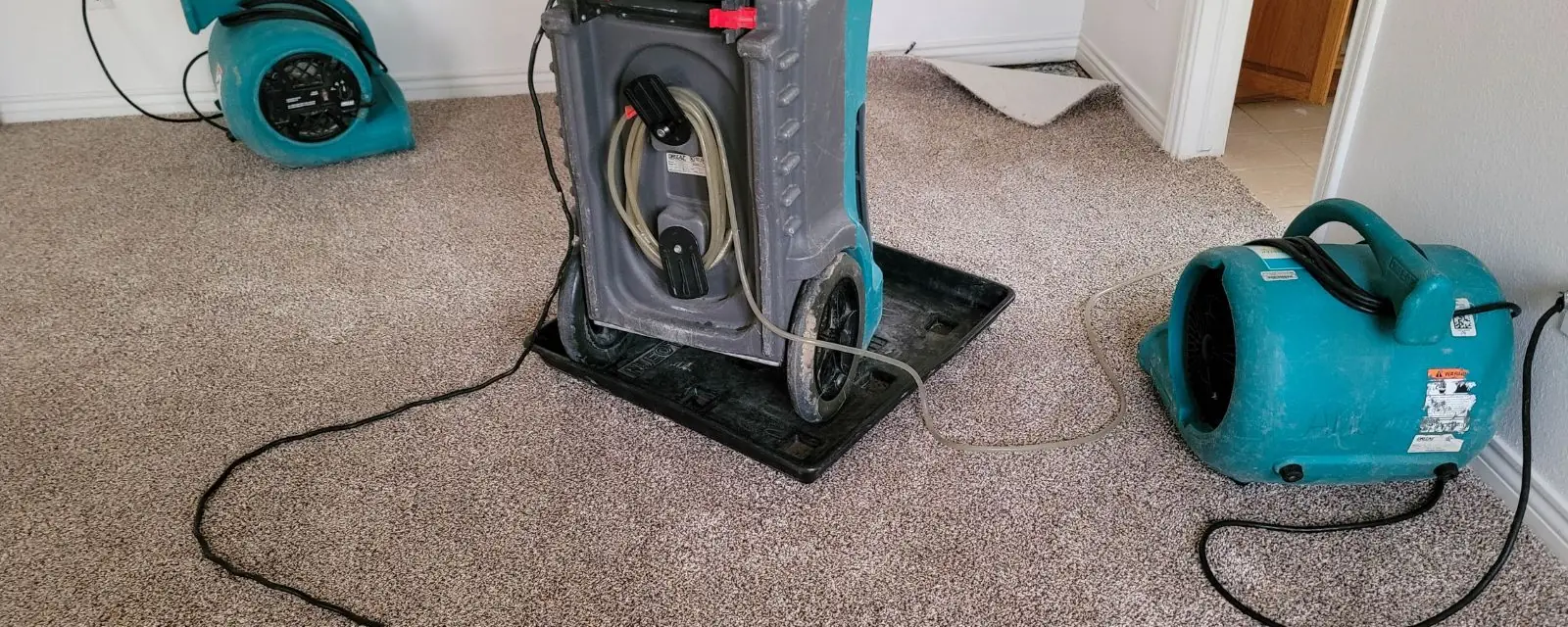
- Set the drying system. Air movers push air across wet surfaces and low grain refrigerant (LGR) dehumidifiers pull the moisture out of the air so drying keeps going.
- Monitor daily. The crew returns, repeats readings and adjusts equipment until each material reads dry. Then the equipment comes out.
Ask for the readings in writing. They show your insurer how the loss was measured and when drying was finished.
Structural drying: where most of the time goes
Structural drying is the part homeowners underestimate. Water that soaks into the bottom plate of a wall, a hardwood subfloor or the cavity above a ceiling does not leave by itself. Crews often drill small holes, lift baseboards or cut a short flood cut in drywall so air can reach wet cavities.
Drying takes days, and the calendar is not the measure. Readings are. A floor that feels dry to the hand can still hold enough moisture to cup boards or feed mold, which is why a crew checks the same spots day after day instead of leaving equipment for a fixed number of hours.
If you hear a company promise an exact finish time before they have taken a single reading, ask what the promise is based on.
What gets dried, what gets removed
Not everything is worth saving, and a good crew explains the reasoning. The table is a decision framework, not a quote.
| Material | Usually dried in place | Usually removed |
|---|---|---|
| Hardwood and engineered flooring | Clean water caught early, with floor drying mats or panels | Boards that are cupped, delaminated or soaked for days |
| Drywall and plaster | Clean water, caught quickly, with cavity drying | Sagging, stained or contaminated board |
| Carpet and pad | Carpet from clean water, if dried fast | Pad in almost every case, and carpet exposed to contaminated water |
| Insulation | Rarely worth drying once soaked | Wet batts and blown-in material in wet cavities |
| Cabinets and trim | Solid wood that has not swollen | Particleboard that has swollen or lost its finish |
Why older North Richland Hills homes need a closer look
North Richland Hills grew from 8,662 people in 1960 to 45,895 in 1990, so a large share of its houses are now several decades old. In Smithfield, which the city annexed by 1960, and in the Cummings Drive area, where the Jones dairy farm was subdivided starting in 1952, original supply lines, water heaters and drain connections have had a long time to wear.
That is a practical reason to look past the obvious stain. If one fixture failed, ask the crew to check neighboring walls and the slab edge for moisture, because aging plumbing often fails in more than one place.
Weather adds its own pattern. The National Weather Service lists an average of 29 freezes per season for the Dallas/Fort Worth station and a normal of 37.01 inches of rain a year, so burst pipes after a hard freeze and wind-driven rain through weak roofs are both worth planning for.
Water spreading right now?
Call the 24/7 line. Scope and price are explained before work starts, and a crew can be dispatched the same day when available.
What drives the cost of mitigation
We do not quote from a photo, and no honest company can. A real number depends on a handful of facts that only an inspection reveals.
- The water category: clean supply water, gray water or contaminated water changes the labor and what must be removed.
- How many square feet and how many rooms are wet, including the cavities behind finishes.
- The materials involved, since hardwood, plaster and engineered flooring dry differently.
- How many days of drying and how much equipment the readings call for.
- How much demolition and rebuild the drying leaves behind.
Sudden and accidental water damage is often covered by homeowners insurance, while gradual leaks and neglect often are not, and flood damage usually needs a separate flood policy. Check your policy and ask your insurer. If you want your real number, call (817) 623-9267 and a dispatcher will explain how the scope is set.
Where mitigation fits in the full job
Mitigation is step one. When standing water is gone and the structure is dry, water damage cleanup handles debris, sanitizing and deodorizing, and water damage repair rebuilds drywall, flooring and paint. If a pipe burst and the water is still on the floor, emergency water removal is the page to read first.
We dispatch across North Richland Hills and to nearby towns, including Hurst to the south, so the same line answers whether the leak is in Smithfield, near Davis Boulevard or in a neighboring city.
Questions we hear from North Richland Hills homeowners
Yes. Dispatch answers 24/7, including nights, weekends and holidays. We never promise an exact arrival time, but we offer same-day response when crews are available, and the dispatcher will tell you what to do while you wait.
Mopping removes the surface layer. Water that soaked into pad, subfloor, baseboards and the bottom of walls stays behind, and it keeps spreading. Mitigation measures that hidden moisture and dries it with air movers and dehumidifiers.
It often takes several days, but the readings decide the finish, not the calendar. The crew checks moisture daily and removes equipment only when each material reads dry.
Rental fans move air but do not map moisture or find wet cavities, and a household dehumidifier is far smaller than the equipment a crew uses. Drying without readings often stops too early. If you only want to know what a crew would check, ask the dispatcher to walk you through it.
Sudden and accidental damage is often covered, but your policy language decides. Notify your insurer early, photograph the damage and keep damaged materials until the adjuster has seen them.
Stop the water at the main valve, lift valuables off wet floors, keep people and pets out of affected rooms and avoid electrical equipment on wet surfaces. If sewage or creek water is involved, stay out of it.