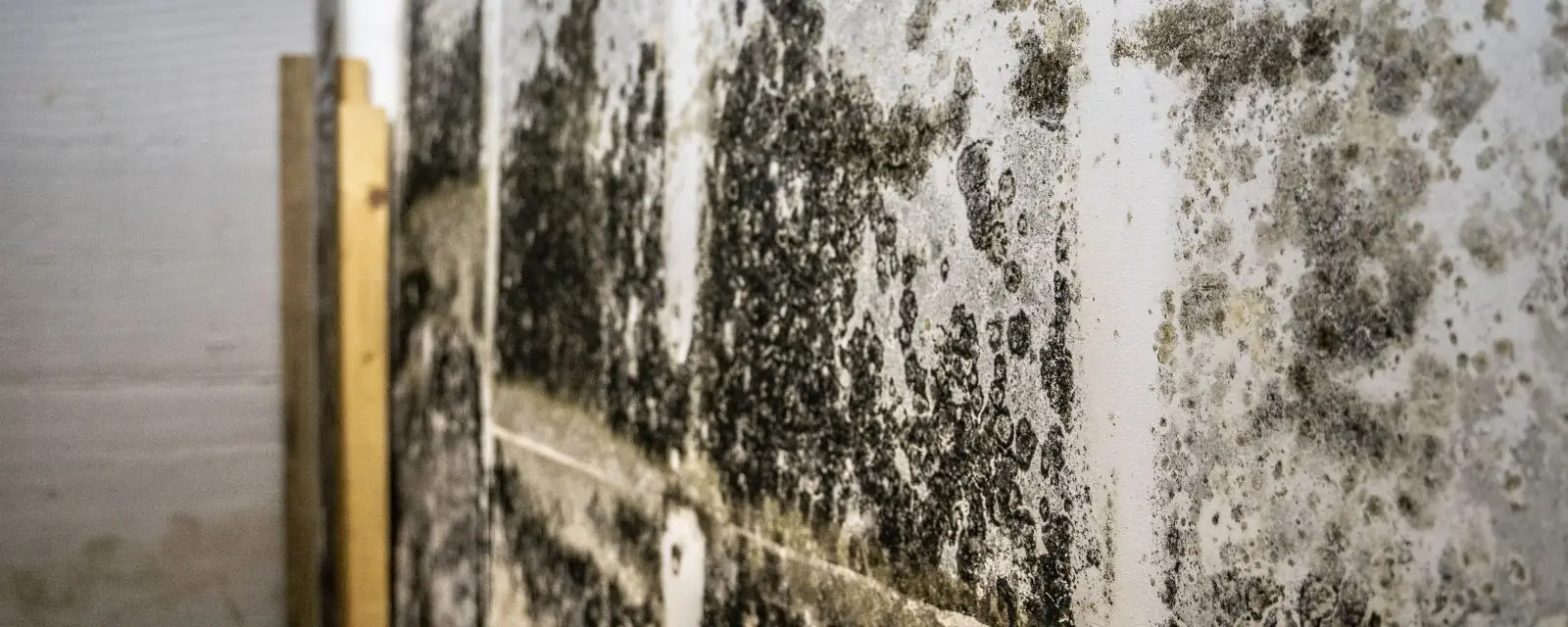
Find the moisture before you touch the mold
To get rid of mold in a basement, start by finding and stopping the moisture, because mold cannot grow without it. Wiping a stain while a wall wicks groundwater or a pipe drips only gives you a clean spot that turns dark again. Fixing the source comes first, every time.
Walk the lower level with a flashlight and look at where the stains sit. A line along the base of a wall points to water from the slab or the soil. A stain under a bathroom or kitchen points to a plumbing leak, and a ring on a ceiling points to something above.
Check the outside as well. Gutters that dump at the foundation, soil that slopes toward the house and a clogged window well all send water to the same wall.
No basement? The same steps apply
Whether your home has a basement, a crawl space or neither changes where water collects, but not the method. The same steps apply to a garage, a utility closet, a lower-level room or a crawl space, anywhere damp air and building materials meet.
Crawl spaces deserve a note. They are cramped and often hold insulation and wood framing, so a small visible patch can mean a larger hidden area. If you cannot see all of the space safely, a crew can inspect it.
Wipe it yourself or call: a decision guide
Size and material matter more than color. The table separates a job a homeowner can handle from one that needs containment, meaning plastic barriers and controlled airflow so spores do not move into clean rooms.
| What you see | Reasonable homeowner step | When to call a crew |
|---|---|---|
| A small spot on tile, sealed concrete, glass or metal | Wipe with detergent and water, then dry the surface fully | If it returns within days, which means moisture is still present |
| Staining on unfinished concrete or block | Scrub lightly and dry, then look for the water source | If the wall feels damp or shows white mineral crust |
| Growth on drywall, paneling or ceiling tile | Do not scrub, since it spreads the problem | Call, because porous material is usually removed |
| Carpet, pad or rugs that smell musty | Lift a corner to look and photograph | Call, because these usually cannot be cleaned in place |
| Visible growth on framing, insulation or in a crawl space | Stay out of the area and stop the water | Call for assessment and containment |
| A musty smell with no visible source | Look behind stored boxes and furniture | Call if you cannot find it, since the source may be inside a wall |
Wear gloves and eye protection even for a small wipe, and keep the fan pointed outside the house. There is no safe shortcut for anything larger than a small hard surface.
Why bleach does not fix porous material
Drywall, wood, carpet and insulation are porous, which means moisture and growth reach below the surface. A liquid sprayed on top treats what you can see and leaves what is inside. The moisture that fed the mold is also still there, which is the real cause.
A cleaner smell or a whiter surface can feel like success, which is why people spray, paint over and move on. Paint over mold does not remove it, and it hides the early signs that would tell you the leak is back.
Mold in your lower level?
Call the 24/7 line. We explain scope and price before work starts, and we can dispatch a crew.
Source hunt checklist for a damp lower level
Use this list before you decide what has to be removed. Photograph each finding with a date, because the notes help an insurer, a plumber and a crew.
- Run a hand along the base of every exterior wall and note any damp or cold spots.
- Look under sinks, behind the water heater and around the washer for drips or rust stains.
- Check exterior gutters and downspouts, and note whether the discharge ends at the foundation.
- Look at the soil next to the house to see if it slopes toward the walls.
- Inspect window wells for debris, standing water or a cracked seal.
- Feel the underside of the floor above in a crawl space for dampness or sagging insulation.
- Run a dehumidifier for a day and see whether the room smells different.
A leaking pipe or a failed seal is a repair for a plumber or contractor. Drying and removing damaged materials is the crew's part, and both have to happen before rebuilding.
North Richland Hills homes and drainage: why a lower level can run damp
The city says its population grew from 8,662 in 1960 to 45,895 in 1990, so many homes here are decades old. Older homes can have aging plumbing, older foundations and grading that has settled, which is why a damp wall in a home that never had trouble before is worth a close look.
The city also says even very small streams, gullies, creeks, culverts and dry streambeds can flood. If your lot sits near a drainage path, a heavy storm may push water toward a garage, a crawl space or a lower-level room even when the house is dry in ordinary weather.
The city keeps floodplain reference material at the public library and at Public Works at City Hall. Ask Public Works whether a drainage question about your lot is something staff can discuss.
What containment and removal look like
A crew that handles mold remediation seals the work area with plastic, controls airflow and removes the affected material before drying and cleaning the structure. Testing and cleanup follow the ANSI/IICRC S520 standard.
Texas licenses mold assessors and remediators through the Texas Department of Licensing and Regulation. Ask the company whether it holds the Texas license that applies to your project, and ask the state how the rules apply to your job.
If the lower level took on water, the water damage repair page explains what rebuilding looks like once the area is dry.
Homes in the neighboring cities
Lower levels in Keller and Colleyville get the same advice. Find the moisture, handle only what is small and hard, and call before opening a wall.
Questions we hear from North Richland Hills homeowners
Bleach does not reach into porous material, and it does nothing about the moisture that feeds mold. A small hard surface can be cleaned with detergent and water, but fix the water source first.
No. Paint hides growth and does not remove it. Find the source of moisture, dry the wall and have the surface assessed.
Clues include a musty smell, a damp or cold feel, peeling paint and stains that grow. A crew can use a moisture meter, and sometimes needs to open a small section to see.
Yes, for any damp low room. A garage, utility closet or crawl space gets the same steps: stop the source, dry the area and call for containment if mold is in porous materials.
Aging plumbing, settled grading and drainage paths near the lot are common reasons. City history records the population growing from 8,662 in 1960 to 45,895 in 1990, so many homes are decades old.