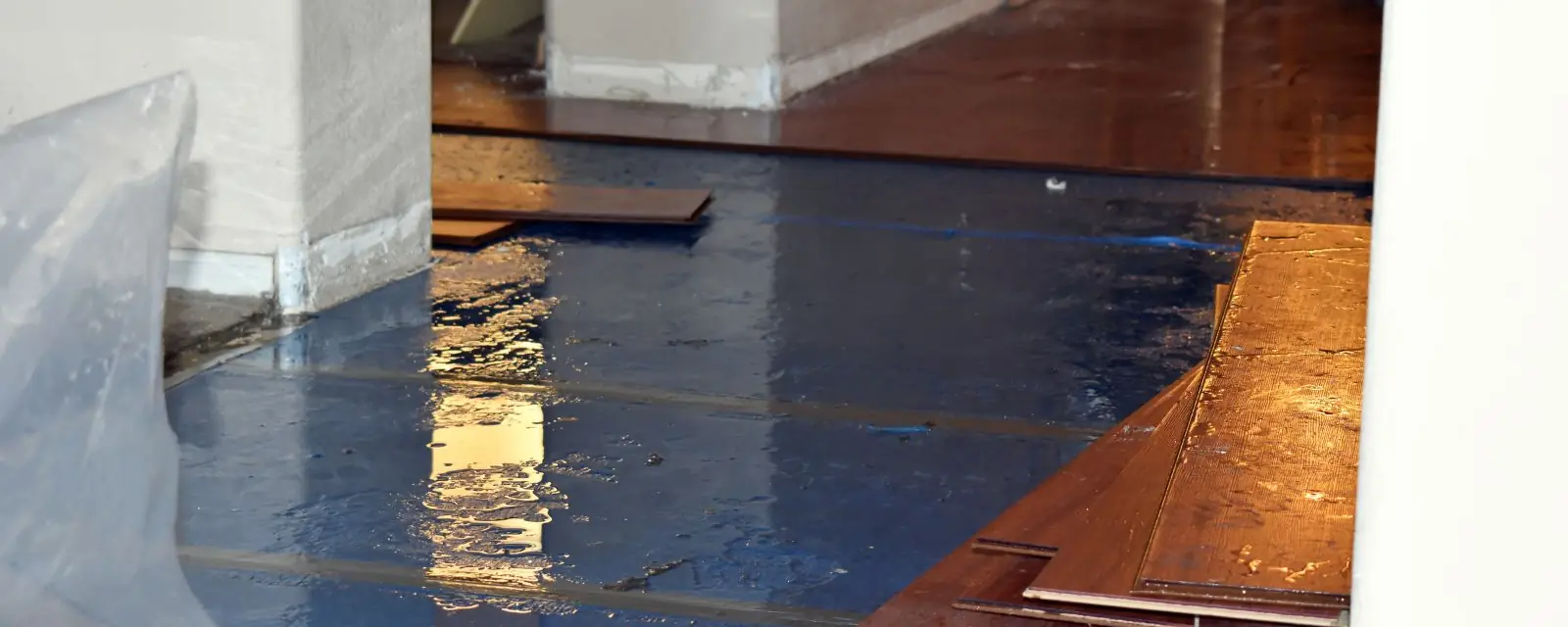
Can water damaged hardwood be saved?
Often yes, if the floor is dried quickly and the subfloor has not stayed wet for long. Solid and engineered wood both absorb water through the edges and underside, so the damage begins below the surface. A floor that looks fine on day one can warp by day five.
Whether boards are saved or replaced depends on three things: how long they stayed wet, how much water reached the subfloor, and how the floor is attached. A crew answers all three with a moisture meter, not by eye.
The type of floor matters as well. Solid strip and plank floors move more than engineered boards, and floors glued directly to a slab behave differently from floors nailed over a plywood subfloor. Industry practice for drying is published in ANSI/IICRC S500.
What to do before you start
- Stop the water source before anything else.
- Keep power off to wet areas if you can reach the panel from dry ground.
- Lift rugs and furniture off the boards, then photograph the damage.
- Ask for moisture readings before deciding whether boards can stay.
Cupping, crowning and buckling are different problems
Cupping happens when board edges rise higher than the center, because the underside absorbed more moisture than the top. Crowning is the opposite. The center rises higher than the edges, which often shows after a cupped floor is sanded before it fully dried, or when moisture came from above.
Buckling is the serious one. Boards lift off the subfloor, sometimes in tents several inches high, because swelling has overcome the nails or adhesive. Buckled floors usually need partial or full replacement, while mild cupping can flatten out as the floor dries.
| Condition | What it looks like | Usual outlook |
|---|---|---|
| Cupping | Edges raised, centers lower | Often flattens after controlled drying, then may be sanded |
| Crowning | Centers raised, edges lower | Check moisture first, since sanding too early causes it |
| Buckling | Boards lifting off the subfloor | Often replacement of the affected area |
| Staining or black spots | Dark marks in wood or finish | Depends on depth, may need board replacement |
Why speed decides the outcome
Wood is a sponge. Each day it stays above its normal moisture content, swelling puts stress on the tongue-and-groove joints, and finish can crack. Mold also starts to grow on wet wood and the subfloor within days.
This is why crews start extraction first and then pull water out of the boards with air movement and dehumidification. A floor that sat under a closed rug for a week is a far harder case than one that got a crew the same morning.
If you see water on a hardwood floor, soak it up with towels, lift furniture and rugs off the surface and leave the rest to the crew. Do not run a heater or point a hot fan at the floor, because rapid surface drying can split boards and leave the underside wet.
What flooring crews check before they decide
A flooring inspection is mostly measurement. The crew compares readings in the boards and subfloor against a dry reference reading from an unaffected room. They also look at the type of installation, since glued-down floors behave differently from nailed ones.
Moisture content in the boards, readings in the subfloor, the adhesive condition and the state of the finish all matter. Ask the crew to show you the numbers and to mark readings on the floor so you can see progress each day.
- Moisture readings in the boards and in the subfloor below them.
- A dry reference reading from an unaffected room in the same house.
- Whether the floor is nailed, stapled, floated or glued down.
- Condition of the finish and whether water has lifted the seams.
- Whether boards sit tight or have started to lift at the ends.
Floor wet right now?
Call the 24/7 line. We can dispatch a crew and we explain scope and price before work starts.
Washer valves, condensate lines and other slow leaks
Two common sources of hardwood damage are a washer supply hose or valve and the condensate drain line of an air conditioner. Both can leak at a trickle for weeks. The water usually travels under the baseboard and into the edge of the floor, so the first sign may be a cupped board near a wall.
Slow leaks matter because they raise the moisture content of boards and subfloor without leaving a puddle. If you find a damp spot near a laundry closet or an AC closet, shut off the source and call a crew before the cupping spreads. Our water damage repair team can take readings and tell you whether the floor can be dried in place.
Drying systems, sanding and replacement
When boards can be saved, crews use floor drying systems. Moisture mats and low-profile vents pull air through the floor surface, and lifting a few boards sometimes opens a path to the subfloor. Pulling baseboards helps too.
Once readings are normal, sanding and refinishing can remove cupping and surface staining. If boards stay lifted, split or stained black, individual boards or sections are replaced and blended into the old floor. A new finish usually has to cover the whole room so the sheen matches.
You can read more about early steps on our water mitigation page.
Ask for the plan in writing. It should say which boards are expected to stay, which may go, and what moisture reading will decide it.
North Richland Hills notes: rain, older homes and finishes
The National Weather Service records an annual precipitation normal of 37.01 inches at Dallas/Fort Worth for 1991 to 2020. That is a lot of rain falling on roofs, lawns and slabs each year, so a floor near a door, a wall or a laundry closet can meet moisture more than once.
North Richland Hills grew from 8,662 people in 1960 to 45,895 in 1990, so many homes are decades old. Older floors may have thick or aged finish, and older houses can have older supply lines and appliance connections. If your floor is decades old, ask the flooring crew how much finish remains before sanding.
Nearby cities with the same floors
Homes in Hurst and Keller face the same leak sources, and the same dispatch line covers them. The moisture checks and decision rules above apply in either place.
Questions we hear from North Richland Hills homeowners
It varies with the species, how long the wood was wet and how much water got under the floor. A crew should give you daily moisture readings instead of a fixed day count.
Slow drying is usually better than fast drying, because boards that dry unevenly can crack or cup the other way.
Sometimes, once they dry slowly and fully. Sanding too early can leave crowning, so wait for normal readings before refinishing.
It is better to let a crew decide. Pulling boards without readings can damage tongues and grooves that were still savable.
Sometimes. Engineered boards have a plywood core and a thin top layer, so delamination at the edges is a common reason they are replaced.
No. Surface marks often come out, while dark stains that run deep in the wood may require replacing the board.
A flooring contractor can sand a test patch in a closet or under a vent to show what the finish will look like.